Architectural Photography: An Introduction by I Still Shoot Film & Milosz Siebert
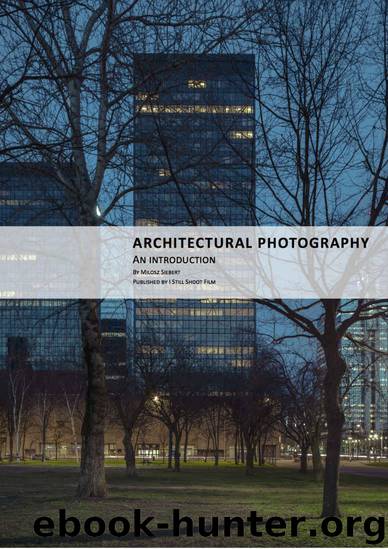
Author:I Still Shoot Film & Milosz Siebert [Shoot Film, I Still]
Language: eng
Format: azw3
Publisher: UNKNOWN
Published: 2017-06-05T04:00:00+00:00
Accessories
Tripods Architectural photography usually requires either precise composition, stopping down the lens for more depth of field, long exposure times, or more often than not – all those factors combined. Thus, the use of a good, sturdy tripod is more than recommended. Some tripods have the option to invert the central column, allowing you to place the camera underneath the tripod, which is great for extremely low point
-of-view imagery.
Tripod heads Although any tripod head can be used, if you want to precisely adjust your framing, a geared head is the way to go. The typical approach either with standard tripod heads or ball heads would be to unlock it, adjust the camera’s position and to lock it again. The difficulty here is that positioning the camera precisely can be a hassle – which is where geared movements come in. They allow you a choice between the standard approach while at the same time letting you adjust the camera’s position in really small increments. All this makes precise composition much, much easier. The Manfrotto 410 or the 405 heads are a great value for money; the MHXPro-3wg is cheaper but features a much smaller base plate (making it suitable for 35mm systems more than anything else). When budget is not an issue, the Arca- Swiss C1 Cube Geared Head is worth trying.
Filters One of the more useful filters you could get would be a polarizing filter, which will greatly increase contrast, saturation, and reduce unwanted reflections and haze (including in the air, resulting in very saturated blue skies). It will greatly help to delineate a building’s structure or silhouette when set against a clear blue sky.
For those working with black -and-white film : yellow, orange and red filters will work fine as well – they will increase the contrast of your image and darken the sky. One thing to keep in mind as far as view cameras are concerned since there is no TTL metering involved in this case is that each of these filters requires a filter factor to be applied to your exposure. These are usually indicated directly on the filter ring. Should that not be the case, here are the most common filter factors and exposure compensation which need to be applied:
Yellow 2X increase exposure by 1 stop
Orange 4X increase exposure by 2 stops Red 8X increase exposure by 3 stops Green 8X increase exposure by 3 stops
Polarising increase exposure by 1.5 to 2 stops (depending on the manufacturer)
Filters can be very helpful in accentuation patterns and the overall graphic statement of an image, as is the case in the photograph above.
Download
This site does not store any files on its server. We only index and link to content provided by other sites. Please contact the content providers to delete copyright contents if any and email us, we'll remove relevant links or contents immediately.
Shoot Sexy by Ryan Armbrust(17788)
Portrait Mastery in Black & White: Learn the Signature Style of a Legendary Photographer by Tim Kelly(17052)
Adobe Camera Raw For Digital Photographers Only by Rob Sheppard(17031)
Photographically Speaking: A Deeper Look at Creating Stronger Images (Eva Spring's Library) by David duChemin(16735)
Bombshells: Glamour Girls of a Lifetime by Sullivan Steve(14136)
Art Nude Photography Explained: How to Photograph and Understand Great Art Nude Images by Simon Walden(13092)
Perfect Rhythm by Jae(5460)
Pillow Thoughts by Courtney Peppernell(4328)
The Book of Joy by Dalai Lama(4039)
Good by S. Walden(3603)
The Pixar Touch by David A. Price(3480)
A Dictionary of Sociology by Unknown(3114)
Fantastic Beasts: The Crimes of Grindelwald by J. K. Rowling(3086)
Stacked Decks by The Rotenberg Collection(2926)
Humans of New York by Brandon Stanton(2907)
Read This If You Want to Take Great Photographs by Carroll Henry(2737)
On Photography by Susan Sontag(2672)
Insomniac City by Bill Hayes(2595)
Photographic Guide to the Birds of Indonesia by Strange Morten;(2571)
